![[personal profile]](https://www.dreamwidth.org/img/silk/identity/user.png)
Dec. 26th, 2016


via http://ift.tt/2ik83WS:
copperbadge:
drgaellon:
mcavoys:
Sebastian Stan attends the Skin Cancer Foundation Media Awards Gala at the Mandarin Oriental New York on October 18, 2016.
@copperbadge this may be too generic a photo for RDJ to comment upon…
“Nothing is too generic for my attention, Sebastian. Don’t I advise all of the Chrises on their life choices?”
“There’s just not that much to say, though, Robert. It’s a nice navy suit.”
“Okay, first of all, there’s something up with that jacket but I’m not sure what. More importantly, however, you need to grow out your hair on the sides and get a shave because right now your face looks three feet tall.”
“…you’re all heart, Robert.”
“Well, at least you’re not generic, Sebastian.”
[RDJ Advises Chris Evans Sebastian Stan on his Life Choices]

copperbadge:
drgaellon:
mcavoys:
Sebastian Stan attends the Skin Cancer Foundation Media Awards Gala at the Mandarin Oriental New York on October 18, 2016.
@copperbadge this may be too generic a photo for RDJ to comment upon…
“Nothing is too generic for my attention, Sebastian. Don’t I advise all of the Chrises on their life choices?”
“There’s just not that much to say, though, Robert. It’s a nice navy suit.”
“Okay, first of all, there’s something up with that jacket but I’m not sure what. More importantly, however, you need to grow out your hair on the sides and get a shave because right now your face looks three feet tall.”
“…you’re all heart, Robert.”
“Well, at least you’re not generic, Sebastian.”
[RDJ Advises Chris Evans Sebastian Stan on his Life Choices]
via http://ift.tt/2hHQ5gc:
vox:
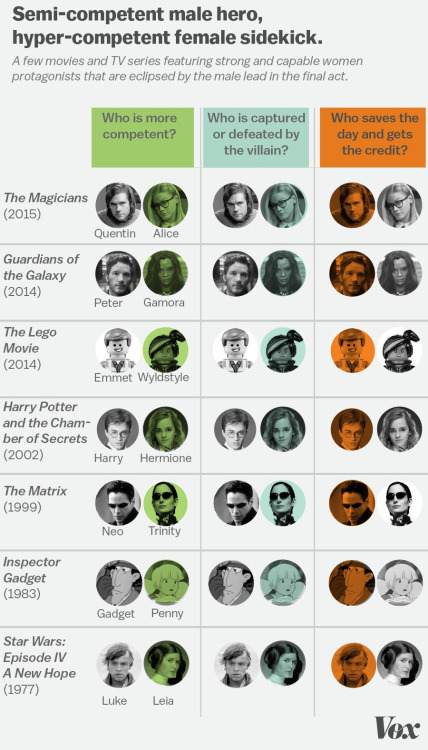
Every semi-competent male hero has a more talented female sidekick. She should be the star.
The trope is part of the double-edged sword of our very, very slow crawl toward telling more diverse stories across all forms of media. Culturally, we’ve begun to realize that it might be a good idea to expand our focus to include more than straight white cis men — but even as we begin to include more women and queer people and people of color and trans people in our stories, we continue to overwhelmingly reserve the hero role for straight white cis men. Everyone else is relegated to supporting roles.
(This, incidentally, is part of why so many lesbians and people of color die on TV: We’re creating more roles for them, but not necessarily hero roles. Supporting roles. Disposable roles.)
To be clear, I’m not saying that every story with a competent female sidekick and a semi-competent male hero is necessarily bad or even anti-feminist. The problem with this trope lies less in its individual occurrences and more in its sheer prevalence. As with the Bechdel test, the analysis that grows out of looking at this trope is most interesting when it’s directed at overall trends, not at isolated instances.
Because however well-intentioned any particular story’s use of the competent female sidekick trope might be, the enormous accumulated mass of these stories sends a very different message. It suggests that no matter how strong and smart and compelling a woman might be, she is still less important, less vital, just less, than any vaguely competent man. And no matter how hard she works, she will never accomplish more than he does.
And that is not how it should be.
vox:
Every semi-competent male hero has a more talented female sidekick. She should be the star.
The trope is part of the double-edged sword of our very, very slow crawl toward telling more diverse stories across all forms of media. Culturally, we’ve begun to realize that it might be a good idea to expand our focus to include more than straight white cis men — but even as we begin to include more women and queer people and people of color and trans people in our stories, we continue to overwhelmingly reserve the hero role for straight white cis men. Everyone else is relegated to supporting roles.
(This, incidentally, is part of why so many lesbians and people of color die on TV: We’re creating more roles for them, but not necessarily hero roles. Supporting roles. Disposable roles.)
To be clear, I’m not saying that every story with a competent female sidekick and a semi-competent male hero is necessarily bad or even anti-feminist. The problem with this trope lies less in its individual occurrences and more in its sheer prevalence. As with the Bechdel test, the analysis that grows out of looking at this trope is most interesting when it’s directed at overall trends, not at isolated instances.
Because however well-intentioned any particular story’s use of the competent female sidekick trope might be, the enormous accumulated mass of these stories sends a very different message. It suggests that no matter how strong and smart and compelling a woman might be, she is still less important, less vital, just less, than any vaguely competent man. And no matter how hard she works, she will never accomplish more than he does.
And that is not how it should be.
via http://ift.tt/2ikS4Yv:
mercurialmalcontent:
johanirae:
dvas0ng:
periegesisvoid:
So vampires don’t show up in film or mirrors, right? What if that applies to literally any kind of sensor. You got some 2000-year-old emissary of the night cussing out an automatic soap dispenser.
automatic doors. AUTOMATIC DOORS
Those light switches that shuts down when they sense lack of activity.
#my favorite kind of vampire#the shitty and inconvenienced one

mercurialmalcontent:
johanirae:
dvas0ng:
periegesisvoid:
So vampires don’t show up in film or mirrors, right? What if that applies to literally any kind of sensor. You got some 2000-year-old emissary of the night cussing out an automatic soap dispenser.
automatic doors. AUTOMATIC DOORS
Those light switches that shuts down when they sense lack of activity.
#my favorite kind of vampire#the shitty and inconvenienced one